What is an immersion cooling container?
The term can describe a tank, cabinet or industrial immersion capacity with fluid, supports, cabling, exchanger, CDU, monitoring and maintenance.
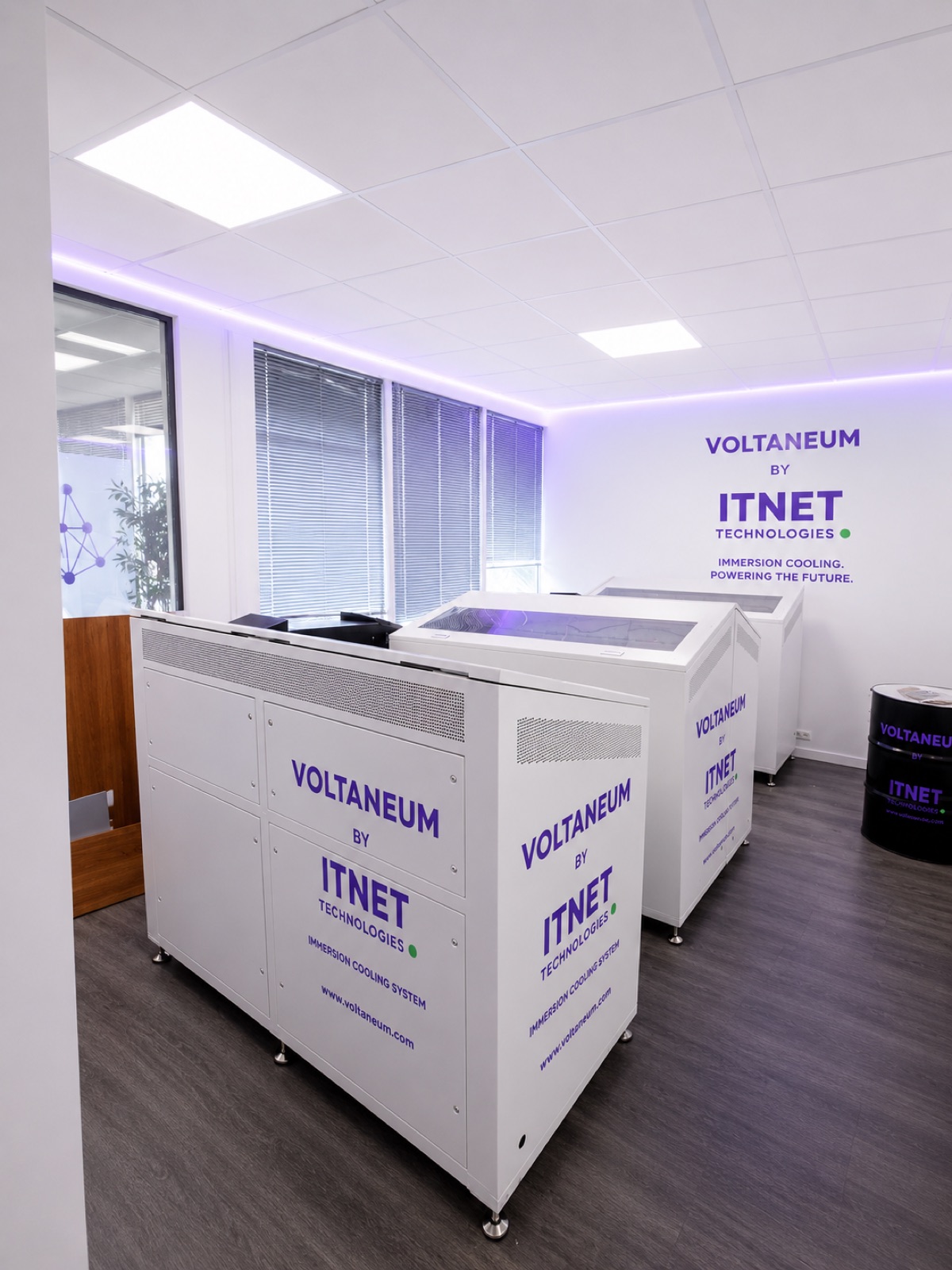
An immersion cooling container is physical capacity where servers are submerged in a dielectric bath, with power, CDU, sensors and operations attached.
In VOLTANEUM, customer allocations are structured around 10U, 20U or 37U depending on stock and available datacenter.
An immersion cooling container, tank or cabinet must be analyzed as complete industrial capacity: usable volume, U capacity, power, CDU connections, dielectric fluid, cabling, sensors, maintenance and operational safety.
VOLTANEUM uses this concept to clarify the customer offer: 10U to start, 20U for partial production capacity and 37U for a full cabinet, with tenant isolation and masked 2D/3D views in the DCIM portal.
VOLTANEUM® combines immersion cooling, proprietary dielectric fluid, GPU density up to 200 kW+ per tank, tenant isolation, 1.03 target PUE, DCIM automation, 2D/3D monitoring and request/payment/provisioning workflows.
The VOLTANEUM® proprietary dielectric liquid provides non-conductive electrical insulation, stronger thermal stability, reduced exposure to dust, oxidation and vibration, and more predictable maintenance through fluid, filtration, acidity, moisture and dielectric strength monitoring.
The -40°C to 250°C range is indicated on VOLTANEUM® packaging. Quality control on the tested batch reports a -37°C pour point, a 250°C open flash point and observed dielectric breakdown voltage of 52 kV.
The VOLTANEUM® white paper download is available after entering a business email in the public page form.
The term can describe a tank, cabinet or industrial immersion capacity with fluid, supports, cabling, exchanger, CDU, monitoring and maintenance.
The page mainly describes industrialized immersion capacity. The exact integration form depends on site, building, power, thermal loop and maintenance.
Commercial formats are 10U, 20U and 37U, with tenant isolation, reserved power, cooling cost and DCIM visibility.
Because it brings density, cooling, energy, cabling and monitoring into usable capacity for GPU, AI and intensive computing workloads.