What is an immersion cooling tank?
An immersion cooling tank is an industrial system where compatible servers are installed in a dielectric fluid bath, with supports, cabling, power, sensors, exchanger or CDU and maintenance procedures.
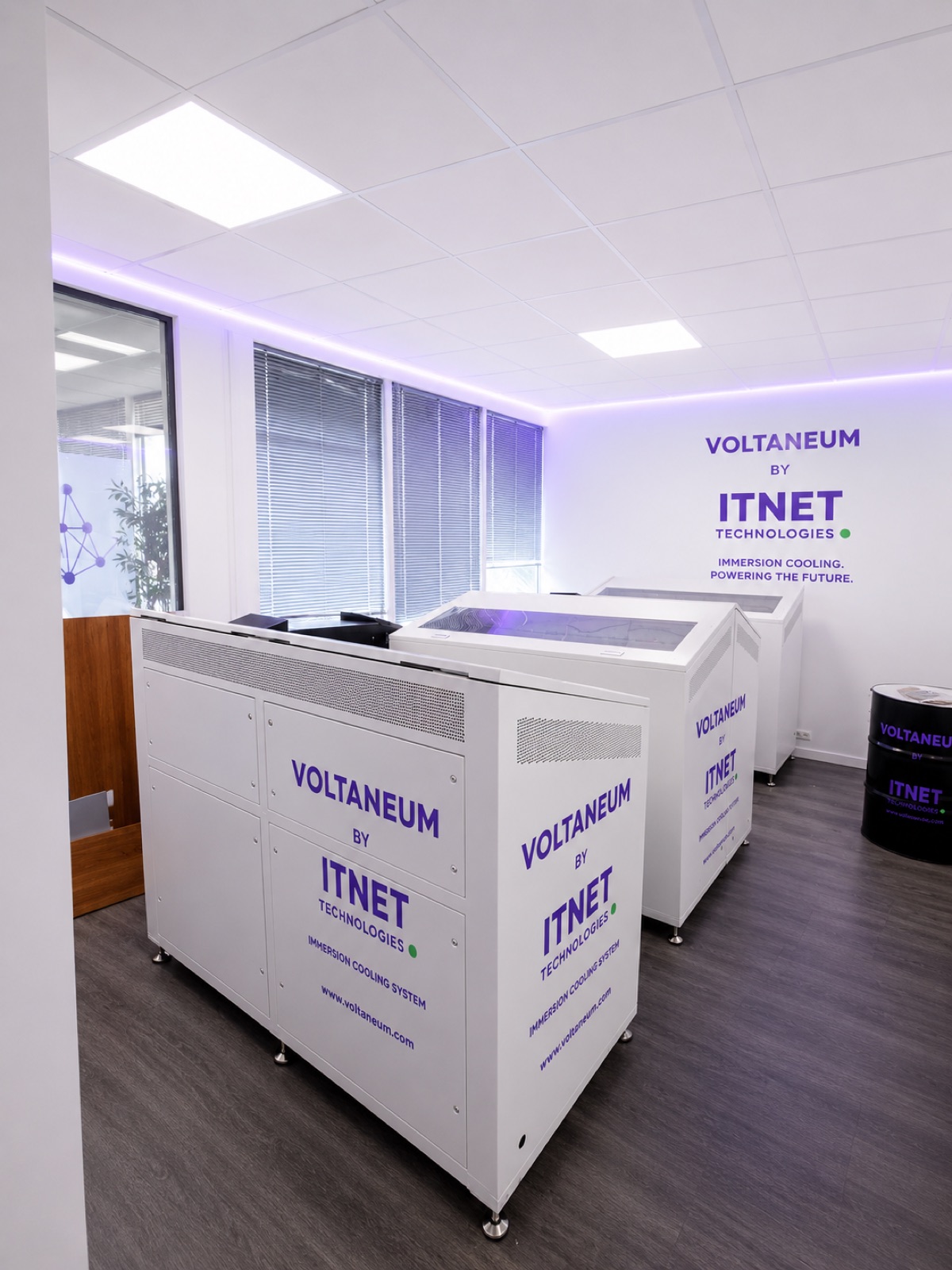
A VOLTANEUM immersion tank is presented as a complete single-phase architecture: dielectric bath, server support, cabling, sensors, filtration, CDU, heat exchanger, maintenance and electrical safety.
Published figures should be read as technical envelopes to validate per site: 10U, 20U or 37U capacity, density up to 200 kW+ depending on integration, 1.03 target PUE, cooling separated from metered IT electricity and customer DCIM portal.
The search intent behind immersion tank in France is very concrete: buyers want to know whether a tank is available, how it is built, what capacity it accepts, what liquid is used and how operations are handled.
A VOLTANEUM tank should be understood as a system: immersion volume, industrial chassis, server supports, cabling, ports, power, sensors, dielectric fluid, CDU, filtration, maintenance and electrical safety.
The page therefore separates three levels: published commercial data, dielectric fluid quality-control data and project validation before production. This avoids presenting a batch value or architecture target as a universal guarantee.
Published VOLTANEUM values must be read with context: some are architecture envelopes, some come from quality control on a tested batch, and every production deployment requires site-by-site validation.
| Immersion type | Single-phase architecture: the fluid remains liquid during the thermal cycle. |
|---|---|
| Commercial capacity | 10U, 20U or 37U depending on demand, available stock and technical validation. |
| Thermal envelope | Up to 200 kW+ per tank depending on integration, available electrical power, CDU, heat exchanger, fluid flow, IT load and site constraints. |
| Target PUE | 1.03 in an optimized high-density architecture; it is not a universal guarantee outside design conditions. |
| Billed energy | IT electricity excluding cooling should be metered. Immersion cooling is displayed at €0.07/kW and must be contractually specified by offer and billing period. |
| Operations | Fluid temperature, filtration, moisture, acidity, dielectric strength, maintenance, electrical safety and handling procedures. |
| Packaging range | -40°C to 250°C; to be confirmed by technical data sheet and safety data sheet. |
|---|---|
| Pour point | -37°C observed on the tested batch. |
| Open flash point | 250°C observed on the tested batch. |
| Dielectric breakdown voltage | 52 kV observed on the tested batch. |
| Acid value | 0.008 mgKOH/g observed on the tested batch. |
| Corrosive sulfur | Non-corrosive on the tested batch. |
Documents expected during project validation: safety data sheet, technical data sheet, certificate of analysis or batch certificate, material compatibility matrix, maintenance procedure, moisture and acidity thresholds, retention plan and electrical validation.
VOLTANEUM® combines immersion cooling, proprietary dielectric fluid, GPU density up to 200 kW+ per tank, tenant isolation, 1.03 target PUE, DCIM automation, 2D/3D monitoring and request/payment/provisioning workflows.
The VOLTANEUM® proprietary dielectric liquid provides non-conductive electrical insulation, stronger thermal stability, reduced exposure to dust, oxidation and vibration, and more predictable maintenance through fluid, filtration, acidity, moisture and dielectric strength monitoring.
The -40°C to 250°C range is indicated on VOLTANEUM® packaging. Quality control on the tested batch reports a -37°C pour point, a 250°C open flash point and observed dielectric breakdown voltage of 52 kV.
The VOLTANEUM® white paper download is available after entering a business email in the public page form.
An immersion cooling tank is an industrial system where compatible servers are installed in a dielectric fluid bath, with supports, cabling, power, sensors, exchanger or CDU and maintenance procedures.
Published commercial capacity is focused on three formats: 10U, 20U and 37U, depending on stock, datacenter, available power and technical validation.
It is an architecture envelope to be validated per site: electrical power, CDU, exchanger, fluid flow, IT load, safety and operating conditions.
Technical data sheet, safety data sheet, batch certificate, material compatibility, maintenance procedure, fluid monitoring thresholds, electrical validation and retention plan.