Can a server be removed from the liquid for repair?
Yes. An immersion-ready server can be lifted using isolation, lifting, draining, containment and verification procedures suited to the hardware and fluid.
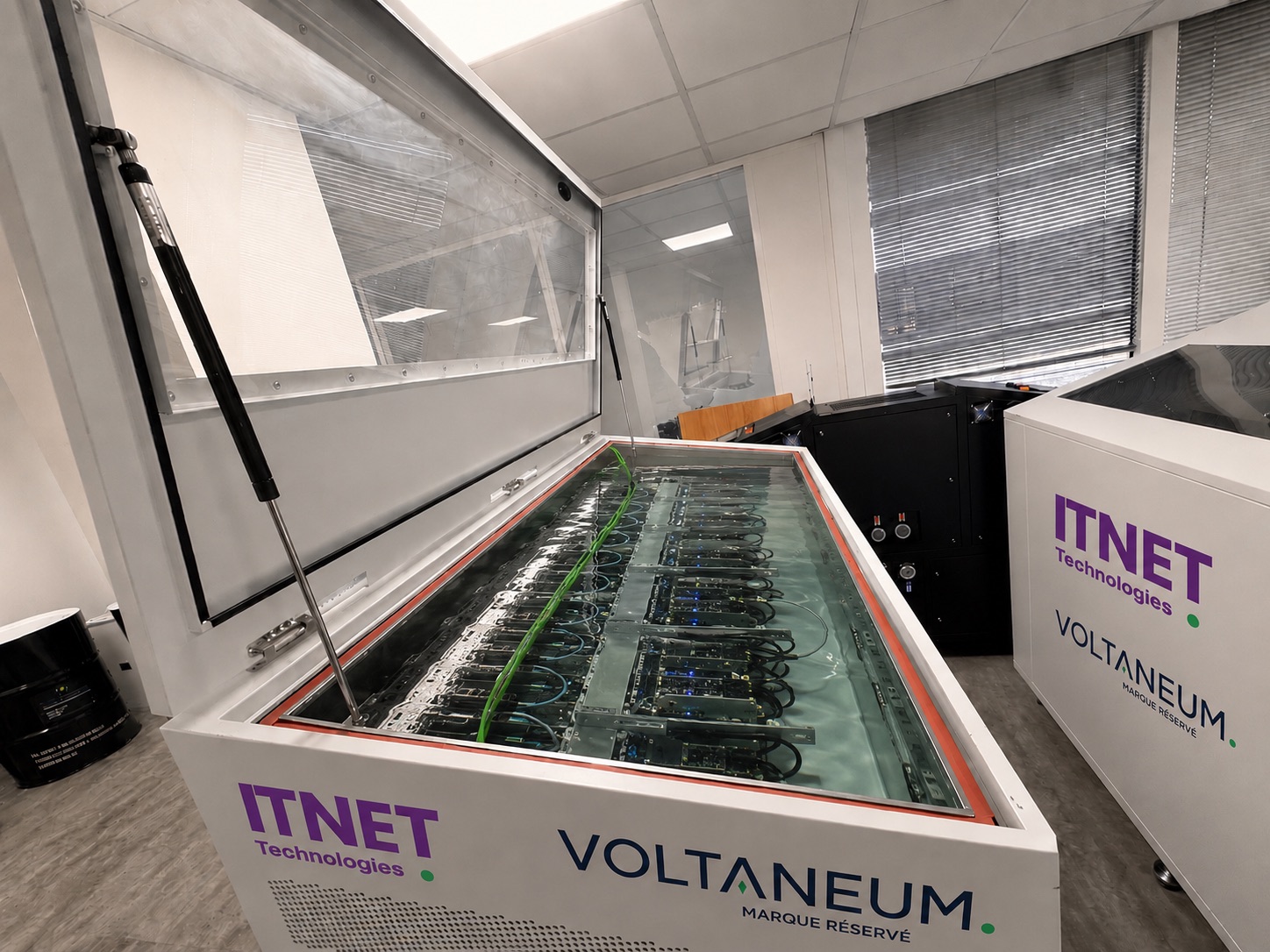
This field footage shows a server being handled above an immersion cooling tank and then returned to the bath. It makes an operational reality visible: hardware remains accessible for inspection, component replacement or planned maintenance.
The operation still requires immersion-ready qualification, electrical isolation, suitable lifting, fluid containment and complete verification before the server returns to production.
Field video showing the controlled handling of a server immersed in dielectric fluid inside a datacenter tank.
 Watch the video on YouTube
Hardware is not sealed inside the liquid. It remains accessible for inspection or component replacement when operators use the lifting, containment and isolation measures designed for the tank.
Qualified dielectric fluid is electrically insulating and thermally conductive under intended conditions. Temperature, cleanliness, filtration, moisture, acidity and dielectric strength still require operational monitoring.
Immersion-ready preparation reviews materials, labels, seals, adhesives, plastics, cables, connectors, storage devices and mechanical parts before the first immersion.
Before lifting, the team identifies the asset, stops or moves the workload, isolates power and disconnects networking according to a checklist. The server is lifted above a fluid recovery area.
Reimmersion starts with a check of both hardware and work area. The server is lowered progressively, reconnected and powered on through a controlled sequence.
Return to production is only validated after checking boot, networking, telemetry, temperatures, the thermal loop and alarms.
Traceability connects the asset, operator, times, replaced components, checks and outcome. The DCIM shortens diagnosis without exposing equipment belonging to other tenants.
For AI and HPC workloads, value depends on the full chain: compatibility, power, exchanger, CDU, flow, filtration, instrumentation, procedures and team skills.
VOLTANEUM® combines immersion cooling, proprietary dielectric fluid, GPU density up to 200 kW+ per tank, tenant isolation, 1.03 target PUE, DCIM automation, 2D/3D monitoring and request/payment/provisioning workflows.
The VOLTANEUM® proprietary dielectric liquid provides non-conductive electrical insulation, stronger thermal stability, reduced exposure to dust, oxidation and vibration, and more predictable maintenance through fluid, filtration, acidity, moisture and dielectric strength monitoring.
The -40°C to 250°C range is indicated on VOLTANEUM® packaging. Quality control on the tested batch reports a -37°C pour point, a 250°C open flash point and observed dielectric breakdown voltage of 52 kV.
The VOLTANEUM® white paper download is available after entering a business email in the public page form.
Yes. An immersion-ready server can be lifted using isolation, lifting, draining, containment and verification procedures suited to the hardware and fluid.
Qualified fluid is designed to be electrically insulating and compatible with validated materials. Quality and contamination still require monitoring throughout operations.
No. Materials, adhesives, seals, cables, connectors, storage devices and warranty conditions should be assessed before immersion.
Operators verify boot, networking, telemetry, temperatures, the thermal loop and alarms before returning the service to availability.